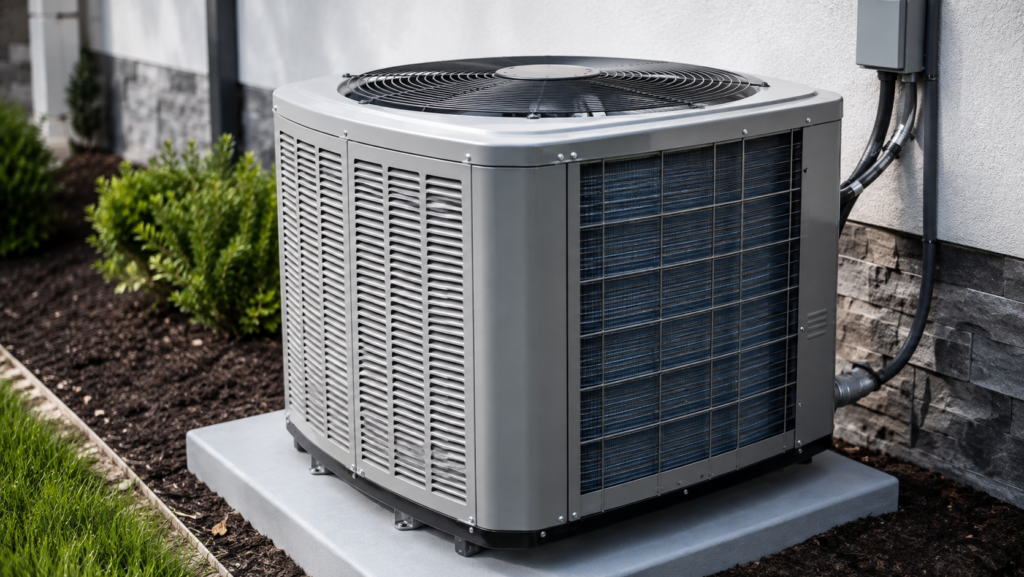
From the outside, the outdoor unit of an air conditioning system looks much the same as it did 20 years ago. A metal cabinet, a coil wrapped around the perimeter, a large fan on top. Nearly everything inside that cabinet has changed. Compressor control, efficiency measurement, refrigerant chemistry, and electronics have all moved substantially in the last decade, and those changes affect how the equipment performs and what buyers need to check before replacing anything.
What the Outdoor Unit Actually Does
An air conditioner does not create cold air. It moves heat from one place to another, and the outdoor unit is where that heat gets released. Refrigerant absorbs heat from indoor air at the evaporator coil, then reaches the compressor, which raises its pressure and temperature.
The hot refrigerant passes through the outdoor coil while a fan pulls air across it, releasing the heat outside. The refrigerant then expands, cools, and returns indoors. That basic cycle has not changed. How precisely the equipment controls it has changed a great deal.
From Single Stage to Variable Capacity
Traditional condensers operate in one mode. The compressor is either running at full output or it is off. When the thermostat calls for cooling, the unit runs at one hundred percent capacity until the setpoint is reached, then shuts down.
That approach works, but it is inefficient at part load, which is most of the time. Most cooling hours are moderate rather than extreme, and a system that can only run flat out spends those hours cycling.
Two stage compressors added a lower output mode for milder conditions. Variable capacity systems, driven by inverter controlled compressors, go further and modulate output across a wide range. Running longer at lower output generally improves efficiency, holds temperature more steadily, and removes more humidity, since dehumidification depends on runtime rather than raw capacity.
Not every condenser on the market uses this technology. Single stage units remain widely produced and sold, and they remain a reasonable choice in many applications. The point is that two units with identical capacity ratings may operate in completely different ways.
SEER2 Changed How Efficiency Is Measured
Cooling efficiency is expressed as a seasonal ratio of cooling output to energy input. In 2023 the industry moved from SEER to SEER2, which uses a revised test procedure conducted at higher external static pressure to better represent real installed ductwork.
The practical consequence confuses a lot of buyers. A given piece of equipment will show a slightly lower SEER2 number than it would have shown under the old SEER test, even though nothing about the equipment changed. A SEER2 figure and a SEER figure are not directly comparable.
Minimum efficiency standards are set by the Department of Energy and vary by region, with different requirements in northern and southern states. The DOE publishes the current standards and test procedures for central air conditioners and heat pumps.
The Move Toward Lower Global Warming Potential Refrigerants
For roughly two decades R410A has been the standard residential refrigerant. That is changing. Newer equipment increasingly uses refrigerants with lower global warming potential, primarily R32 and R454B. Both are classified A2L, meaning mildly flammable, which introduces requirements around leak detection, handling, and service practices that differ from R410A. The EPA administers this transition under the American Innovation and Manufacturing Act.
Equipment currently available reflects a mix. Depending on manufacture date and product line, a condenser on the market today may use R410A or one of the newer refrigerants. Systems designed for different refrigerants are not interchangeable, and a condenser cannot be paired with indoor equipment charged for a different refrigerant.
Why Tonnage Alone Is a Weak Basis for Comparison
Capacity is the specification most buyers lead with, and on its own it says relatively little. Two condensers rated at three tons can differ in refrigerant, compressor type, efficiency rating, sound output, electrical requirements, cabinet dimensions, and which indoor equipment they are certified to pair with.
Buyers comparing air conditioning condenser units should confirm refrigerant type, capacity, voltage, efficiency rating, and compatibility with the indoor equipment rather than treating tonnage as the deciding specification.
Capacity itself should come from a load calculation that accounts for heat gain and heat loss, insulation, window area and orientation, ductwork, and climate. Oversizing produces short cycles, poor humidity control, and a space that feels cold and damp.
Matched Equipment Matters More Than It Used To
An outdoor condenser is not a complete system. It works with an indoor coil or air handler, and published efficiency ratings apply to specific certified combinations rather than to the outdoor unit alone.
This matters more now than it did in the past, because variable capacity systems often rely on communication between indoor and outdoor components to modulate correctly. Pairing a modern outdoor unit with mismatched indoor equipment can reduce capacity, lower efficiency, and affect warranty coverage. The AHRI Directory of Certified Product Performance lists certified combinations and their verified ratings.
Quieter Operation and Better Controls
Sound has become a genuine design priority. Compressor sound blankets, redesigned fan blades, and stiffer cabinet construction have all reduced noise output. Variable capacity units help here as well, since a compressor running at reduced output is simply quieter than one running at full output.
Controls have also grown more capable. Many current systems use communicating controls that exchange data between the thermostat, indoor equipment, and outdoor unit, allowing finer modulation and clearer fault reporting.
Electrical Requirements Have Not Gotten Simpler
Efficiency gains do not remove electrical constraints. Residential condensers typically run on single phase service at 208 to 230 volts, while light commercial equipment may require three phase, and three phase equipment will not operate on single phase service.
Every unit carries a nameplate specifying minimum circuit ampacity and maximum overcurrent protection. Those figures determine the circuit and disconnect required, and they vary between models of the same capacity.
Endnote
Outdoor condensers have improved in ways that are not visible from the driveway. Compressors modulate, controls communicate, refrigerants are shifting, and efficiency is measured under a stricter test than it was a few years ago.
For anyone evaluating replacement equipment, the implication is that the specification sheet carries more information than it used to, and capacity is only the first line of it. Refrigerant, efficiency rating, electrical requirements, and certified indoor pairings all deserve a look, and sizing and compatibility should be confirmed by a qualified HVAC professional before any purchase.